
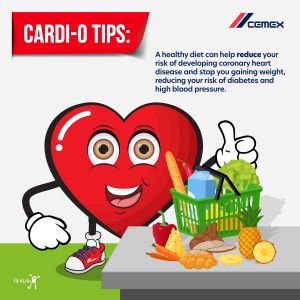
A healthy diet can help reduce your risk of developing coronary heart disease and stop you gaining weight, reducing your risk of diabetes and high blood pressure.
 Consuming a healthy diet throughout the life-course helps to prevent malnutrition in all its forms as well as a range of noncommunicable diseases and conditions.
For adults a healthy diet includes the following:
- Fruit, vegetables, legumes (e.g., lentils and beans), nuts and whole grains (e.g., unprocessed maize, millet, oats, wheat, and brown rice).
- At least 400g (i.e., five portions) of fruit and vegetables per day, excluding potatoes, sweet potatoes, cassava, and other starchy roots.
- Less than 10% of total energy intake from free sugars, which is equivalent to 50g (or about 12 level teaspoons) for a person of healthy body weight consuming about 2,000 calories per day, but ideally is less than 5% of total energy intake for additional health benefits. Free sugars are all sugars added to foods or drinks by the manufacturer, cook or consumer, as well as sugars naturally present in honey, syrups, fruit juices and fruit juice concentrates.
- Less than 30% of total energy intake from fats. Unsaturated fats (found in fish, avocado and nuts, and in sunflower, soybean, canola and olive oils) are preferable to saturated fats (found in fatty meat, butter, palm and coconut oil, cream, cheese, ghee and lard) and trans-fats of all kinds, including both industrially-produced trans-fats (found in baked and fried foods, and pre-packaged snacks and foods, such as frozen pizza, pies, cookies, biscuits, wafers, and cooking oils and spreads) and ruminant trans-fats (found in meat and dairy foods from ruminant animals, such as cows, sheep, goats, etc). It is suggested that the intake of saturated fats be reduced to less than 10% of total energy intake and trans-fats to less than 1% of total energy intake. In particular, industrially-produced trans-fats are not part of a healthy diet and should be avoided.
- Less than 5 grams of salt (equivalent to about one teaspoon) per day. Salt should be iodized.
We have a poster available to display on your local notice boards, which can be found in the download section of the UK News website: Cardi-O Tips poster (1243 downloads )